What Pfizer's VR training can teach pharma, and what its numbers can't
Pfizer's VR training for vaccine manufacturing is one of the best-known cases in pharma. Here is what Pfizer built, what the 40% figure does and does not show, and how to design a pilot that proves its value.

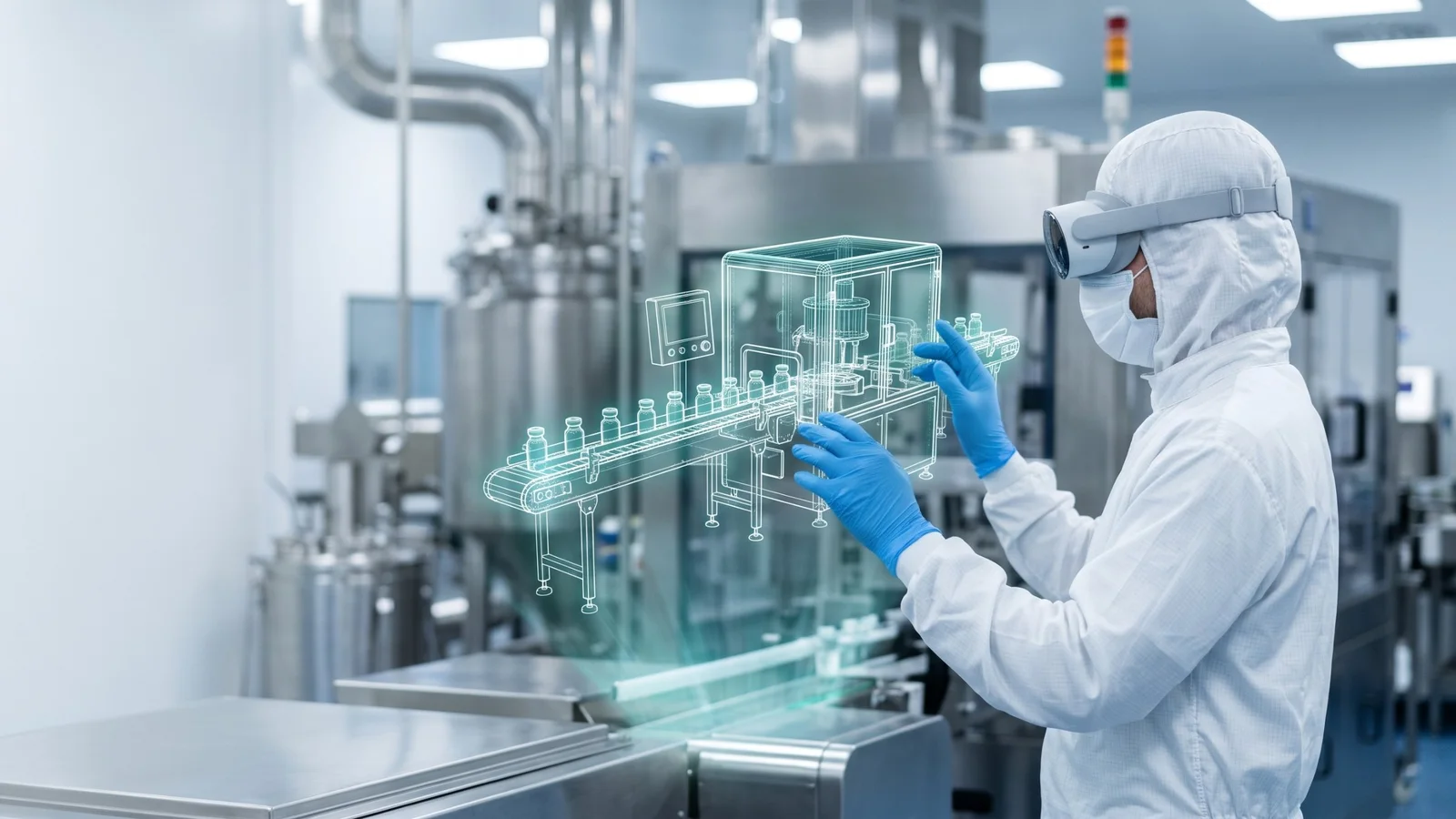
When Pfizer had to train thousands of new manufacturing workers for COVID-19 vaccine production, it turned to virtual reality. The figure that travels with the story is a 40% reduction in total training time.
It is one of the best-known VR cases in pharma, and it deserves attention. It also deserves a careful read, because the evidence behind the number is very different from the evidence behind the Johnson & Johnson surgical trial I wrote about earlier.
What Pfizer built
Pfizer's digital innovation team began exploring extended reality in 2018 and found that VR combined with 3D scanning delivered the most immediate value[3][5]. During the COVID-19 vaccine ramp-up it brought three elements together; Hockley says the VR training rolled out in 2021[5]:
- Digital twins of production lines. Pfizer's Smart Factory team had been 3D-scanning lines since 2019, which gave it virtual replicas of shop floors for onboarding and engineering reviews[2].
- SOPs turned into practice. More than 100 pages of standard operating procedures were converted into interactive VR training, so operators could repeat tasks before touching a real line[1].
- Aseptic technique. Knoxlabs reports that Meta Quest hand tracking and haptic feedback were used to train aseptic technique, with real-time feedback for the trainee[2].
ArborXR, the device-management company Pfizer used, notes that Pfizer has 39 manufacturing sites worldwide, so onboarding is a constant need[1]. Knoxlabs, a Meta for Work partner, reports more than 800 Quest 1 and Quest 2 headsets and remote training across sites in the US and Ireland[2].
What the number does and does not say
The 40% comes from Nick Hockley, Smart Factory Technology Manager at Pfizer, in an interview published by ArborXR: "Our training leads were reporting back, about a 40% reduction in total training time"[1]. In a 2023 podcast he put it in hours: from roughly 700 or more training hours per new joiner to about 400[5]. The ArborXR story also headlines "3x improved quality" without saying how quality was measured; in the podcast, Hockley said quality was not yet quantified and that he expected error reductions to show over about two years[5].
An honest reading:
- It is a practitioner's report, not a study. Training leads reported the hours; there is no comparison group, and no formal measurement method has been published.
- Every public source is commercial. ArborXR sells device management and published both the story and the podcast, Knoxlabs sells Meta Quest solutions, and the consultant's write-up promotes its own services[1][2][3][5]. Meta's original case study now redirects to a general page.
- Time is not competence. Faster onboarding matters in a pandemic ramp-up, but it does not show that operators made fewer errors on the line.
None of this makes the result untrue. Building in-house VR training and rolling it out under pandemic pressure is a real operational achievement. It means the 40% is a credible signal, not proof.
What a measured result looks like
A recent hospital trial shows the other end of the evidence scale. In a randomized controlled trial published in Frontiers in Medicine in 2026, 60 operating-room nurses learned the scrub role for anterior cervical spine surgery. Half trained with a Microsoft HoloLens 2 mixed-reality module and half with video and hands-on instrument practice; both groups also had a lecture[4].
One week later, the mixed-reality group scored higher on knowledge, practical performance and emergency response, with the practical and emergency tests scored by blinded assessors, and reported lower cognitive load. The authors also list the limits: one centre, a modest sample, no test in live surgery and no follow-up beyond a week[4].
That is the shape that convinces a medical, compliance or procurement reviewer: a defined task, a comparison group, independent scoring and stated limits.
Lessons for pharma and medtech teams
Pfizer shows that VR training can work at the scale of a large manufacturer. The trial shows how to prove it works. A good pilot takes from both:
- Start where the pain is operational. Pfizer's case was urgent: thousands of new operators, limited access to production lines and sterile processes. Pick a task where time, risk or access already hurts.
- Reuse what you already have. SOPs, 3D scans and engineering models are training content waiting to be built.
- Write the measurement plan before the content. Define the baseline, the comparison group and who scores performance.
- Measure errors, not just hours. Time saved is the easiest number to collect; fewer deviations on the line is the one a quality team will trust.
- Publish the limits next to the result. Reviewers will find them anyway.
Planning a VR pilot?
At Kucharski Consulting we build VR and AI training for pharma and medtech teams, including patient-perspective simulations. If you are designing a pilot and want to think through what to measure, book 20 minutes with us.
Sources
- ArborXR, "Customer Story: Transforming Training with Pfizer," 3 March 2025 (interview with Nick Hockley, Pfizer). arborxr.com
- Knoxlabs, "Case Study: How Pfizer Used Meta Quest and Digital Twins to Accelerate Global Vaccine Production," 26 March 2025. knoxlabs.com
- ISM Inc., "Pfizer XR/VR/AR Journey Case Study," 9 October 2023. ismguide.com
- "Randomized controlled trial evaluating mixed reality technology for training scrub nurses in anterior cervical spine surgery." Frontiers in Medicine, 2026. PubMed Central
- ArborXR, "Pfizer: Transforming How We Train with XR," XR Industry Leaders podcast, 1 March 2023 (with Nick Hockley, Pfizer). arborxr.com
Kucharski Consulting has no relationship with Pfizer, ArborXR, Knoxlabs or the authors of the trial. All figures come from the public sources above. This article was prepared with the help of AI tools for research and drafting; all facts were checked against the linked sources, and the opinions are our own. The cover image is an illustration, not a photo of a Pfizer facility. Published 25 Oct 2026.