Meta VR Glasses vs Apple Vision Pro, Quest 3S and Steam Frame: A MedTech and Industry Comparison
Which headset fits professional training and industry, not gaming? Specifications, price per seat, comfort and what hands-on testers report, compared for pharma, medtech and industrial teams.

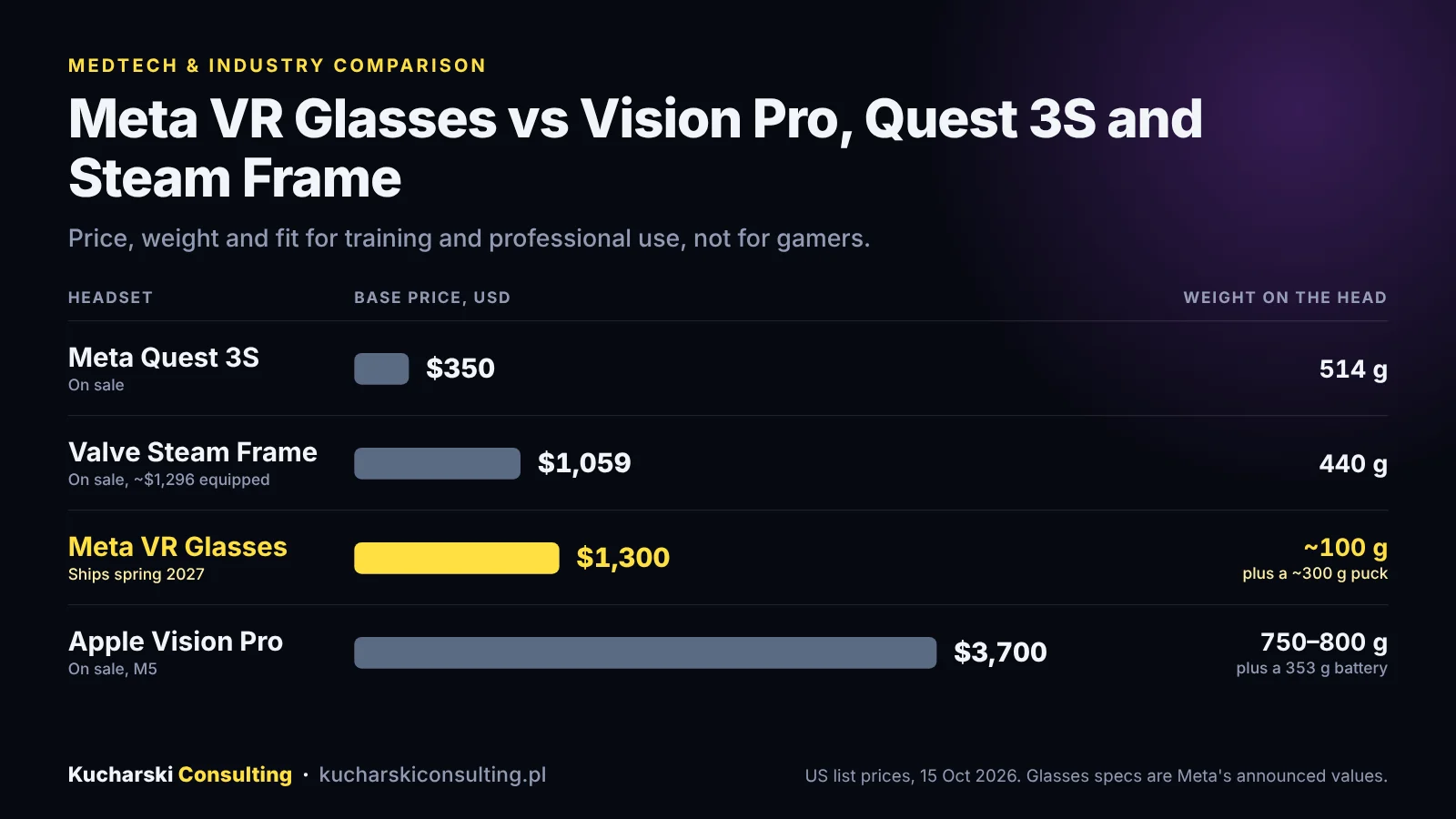
Meta VR Glasses are the lightest and, on paper, the sharpest of the four headsets, but they are announced, not available: they ship in spring 2027 at about $1,300, with no enterprise edition. For professional work today, Meta Quest 3S fits training at scale, Apple Vision Pro fits fidelity-critical visualisation if the budget allows, and Valve's Steam Frame runs standalone but is strongest when streaming from a PC. The glasses are the device to pilot in 2027 for long sessions and desk-based work.
Two caveats shape everything below. Every published hands-on with the glasses is a 20 to 40 minute demo, some on prototype hardware, and none tests clinical or industrial use. And the use-case ratings in this article are my assessment, built from the published specifications and those hands-on reports. Data is as of 15 October 2026.
Specifications side by side
| Meta VR Glasses | Apple Vision Pro (M5) | Meta Quest 3S | Valve Steam Frame | |
|---|---|---|---|---|
| Availability | Spring 2027, no preorders yet | On sale | On sale | On sale since 14 Sep 2026 (reservation lottery) |
| Display | Micro-OLED, 2412 × 2288 per eye | Micro-OLED, 23 million pixels in total | LCD, 1832 × 1920 per eye | LCD, 2160 × 2160 per eye |
| Sharpness and field of view | 37 pixels per degree; 70° × 66° nominal | 7.5 µm pixel pitch; field of view not published by Apple | 20 pixels per degree; 96° × 90° | 110° × 110° (Valve calls it conservative) |
| Refresh rate | Up to 120 Hz | 90 to 120 Hz | Up to 120 Hz | 72 to 144 Hz (144 Hz experimental) |
| Chip and memory | Snapdragon Reality Elite in the puck, 12 GB | Apple M5 plus R1, 16 GB | Snapdragon XR2 Gen 2, 8 GB | Snapdragon 8 Gen 3, 16 GB |
| Weight on the head | About 100 g, plus a puck of about 300 g | 750 to 800 g, plus a 353 g battery | 514 g | 440 g assembled (185 g visor alone) |
| Battery | Up to 3 h, 45 W charging | Up to 2.5 h, external battery | About 2.5 h | No official figure; reviewers saw 45 min to 1 h standalone, 2 to 3 h streaming |
| Input | Eye and hand tracking; controllers optional, not in the box | Eye, hand and voice | Controllers in the box | Controllers in the box; eye tracking; no hand tracking |
| Passthrough | Full colour | Stereo colour cameras plus LiDAR | Full colour, 18 pixels per degree | Monochrome; colour needs a $149 add-on |
| Storage | 128 GB plus microSD up to 1 TB | 256 GB, 512 GB or 1 TB | 128 GB or 256 GB | 256 GB or 1 TB plus microSD |
Sources for the table: VR.org on Meta VR Glasses, Meta's developer page for the 70° × 66° nominal view, Apple's specifications, Road to VR on Quest 3S, VR.org on Steam Frame, and the Tom's Hardware and HotHardware reviews for Steam Frame battery life. The Vision Pro weight includes the Light Seal and Dual Knit Band. The glasses' figures are Meta's announced values; no independent lab has measured them.
Price: purchase cost and cost per seat
A Quest 3S seat costs about a quarter of a Meta VR Glasses seat, and the glasses cost about a third of a Vision Pro. Prices below are US list prices. Meta raised Quest prices on 19 April 2026 and Apple raised the Vision Pro by $200 on 25 June 2026, both citing memory-chip costs, so older price lists are out of date.
| Device | List price (USD) | Realistic extras | 10 headsets | 50 headsets |
|---|---|---|---|---|
| Meta Quest 3S | $349.99 (128 GB), $449.99 (256 GB) | None needed for training | about $3,500 | about $17,500 |
| Valve Steam Frame | $1,059 (256 GB kit with controllers); $1,299 (1 TB) | Power supply $29, grip kit $59, colour passthrough $149: about $1,296 in total | about $10,600 base, about $13,000 equipped | about $53,000 base, about $65,000 equipped |
| Meta VR Glasses | $1,299.99, spring 2027 | Touch Plus controllers and prescription inserts, not yet priced | about $13,000 | about $65,000 |
| Apple Vision Pro (M5) | about $3,700 (256 GB) | Optional accessories | about $37,000 | about $185,000 |
Seat totals are list price times quantity at the base price unless marked; they exclude device management, content and tax. Sources: Game Informer for Quest prices, Road to VR for Vision Pro, VR.org and HotHardware for Steam Frame, and VR.org for the glasses.
The real gap is larger than the sticker gap for fleets: the glasses have no announced management plan, which I cover below, and a Quest 3S pool can be bought and managed today.
Display, performance and comfort outside gaming
Sharpness decides whether text and fine detail are usable. The glasses' 37 pixels per degree is 1.85 times the Quest 3S's 20, and reviewers describe text in multi-screen demos as easy to read (Tom's Guide) and the display as the sharpest mixed-reality screen Engadget's reviewer recalls (Engadget). That matters for procedures, labels and anatomical detail. Steam Frame has more pixels per eye than Quest 3S but spreads them over a 110° view, and reviewers rated its LCD image quality as only "okay" for 2026 (HotHardware roundup).
Field of view is the glasses' main trade-off. Meta's developer page gives 70° × 66° as an upper bound for the visible area and 58° × 54° as a "perceived" test target (Meta). Quest 3 offers about 110° × 96° (Road to VR). Testers disagree on how much it matters: one was not bothered, another found it noticeably narrower, and a third had to turn her head to see each of three windows. Reading, desk work and tasks at arm's length cope with a narrow view; scenarios that depend on peripheral awareness, such as an operating-room team or a hazard walk-through, do not.
Performance is a split decision. The glasses' puck chip has 12 GB of memory and up to 11% higher peak GPU frequency than Quest 3's chip, and one demanding scene appeared to push it hard (Road to VR). The glasses are reported to support the broader Quest library with Touch Plus controllers (Gadget Review), so training content built for Quest should carry over, though controllers are not in the box. Steam Frame's Snapdragon 8 Gen 3 disappointed reviewers standalone, where most PC games run through an emulation layer, but streamed PC games well (HotHardware). Vision Pro carries a laptop-class M5 with 16 GB, which I have not seen benchmarked against the others.
Comfort and weight favour the glasses in short sessions. Testers describe them as barely noticeable, and one reports less face and head fatigue than on a Quest after 20 minutes (Gizmodo). Two cautions: Road to VR found the Standard size clamped and slipped while the Large was very comfortable, and no one has worn them beyond about 40 minutes. The puck is the price of the light face: it needs a belt clip, runs warm, and "creates a snag point" in physical training spaces according to the enterprise-training vendor VR Vision Group. Vision Pro is the heaviest at 750 to 800 g plus a 353 g battery. Steam Frame is light at 440 g, but two reviewers found it much less comfortable without the skull strap, which costs extra.
Shared-pool practicalities. The glasses adjust each lens independently across 56 to 70 mm, which Road to VR found harder to set than a dial, and take Zenni clip-in prescription inserts that are not yet priced (VR.org). Quest 3S offers three fixed IPD positions (58, 63 and 68 mm). The glasses rest on swappable nose pads, which may make wiping down between users simpler, but Meta has published no cleaning guidance; that is my assessment, not a Meta claim.
What people who tried Meta VR Glasses report
The glasses are not on sale, so every published impression comes from a scripted demo at Meta Connect on 23 and 24 September 2026. Road to VR and Gizmodo disclose that Meta covered lodging or travel for their reporters.
| Source and tester | Session | Positives | Concerns |
|---|---|---|---|
| Road to VR, Scott Hayden | About 30 min | Large size very comfortable; passthrough the best he has seen on a standalone headset; deep blacks; hands-in-lap input comfortable | Standard size clamped and slipped; view noticeably narrower than Quest 3; brightness lower than hoped; asymmetric IPD harder to set; eye tracking used only for the interface |
| Engadget, Karissa Bell | About 30 min | Hand and eye input more intuitive than she expected; sharpest mixed-reality display she recalls; secure, not bulky | Had to turn her head to see three windows; keyboard cramped without haptics; puck noticeably warm; one scroll gesture unreliable on prototype hardware |
| Tom's Guide, Mark Spoonauer | 40 min | "Barely felt them"; fluid interface; projected keyboard surprisingly natural; not bothered by the view | Puck "on the bulky side"; no key travel when typing |
| Tom's Guide, Scott Younker | Not stated | Very light and cool on the face; code and web text easy to read | Puck warm; weak selection feedback; keyboard hard without haptics; gestures "need work"; price high |
| Gizmodo, James Pero | 20 min | Comfort the biggest selling point; no fuzziness compared with Quest 3 and 3S; smooth eye and hand tracking | Weaker light blocking than a Quest; slight keyboard lag; puck still to be judged |
| Axios, Ina Fried | About 30 min, prototype | Ran a three-monitor coding session | Meta calls it a "general device" and expects modest sales; no verdict on comfort |
| The Ghost Howls, analyst (did not try them) | Spoke to people who had | Welcomes another option; calls it a good headset at this stage | Split compute a "major compromise"; limited view; $1,300 plus VAT hard to justify; target user unclear |
Where they agree: the glasses are light and sharp in short sessions, the narrow view is noticeable, and the input works but the virtual keyboard lacks haptics. Four of the seven sources flag the puck as warm, bulky or a compromise. None reports on clinical, industrial or long-duration use, and sizing guidance is still open. The enterprise-training vendor VR Vision Group, which did not test the glasses, reaches a similar view: keep building on Quest, design for gaze and pinch input, and pilot the glasses alongside Quest in 2027 (VR Vision Group).
Fit by use case: MedTech and industry
These ratings are my assessment from the specifications, price and tester reports above. None of the four headsets is a cleared medical device; where regulation applies, it attaches to the application and its intended use, so check with regulatory counsel before any clinical claim.
| Use case | Best fit today | Why | Watch out |
|---|---|---|---|
| Clinical skills and onboarding training for many learners | Meta Quest 3S | About $350 per seat, 96° view, controllers in the box, works with third-party device management | Meta's own management tooling is in maintenance mode until 4 Jan 2030 |
| Surgical planning, anatomy and patient-consultation visualisation | Apple Vision Pro | Highest pixel count, colour passthrough with LiDAR, hospital pilots reported (Cedars-Sinai, Stanford; from a vendor directory, unverified) | About $3,700 per headset and 750 to 800 g |
| Long desk-based sessions: SOPs, multi-screen review, remote desktop | Meta VR Glasses, from spring 2027 | 100 g on the face, 37 pixels per degree, virtual multi-monitor workspace | Unproven beyond 40-minute demos; no fleet tools announced |
| Hands-free scenarios and conversational patient simulation | Meta VR Glasses or Quest 3S | Hand and eye input suits scenarios without controllers; Quest 3S is the volume option | Narrow view on the glasses; microphone and AI latency matter more than display |
| Engineering design review and PC-based simulation | Valve Steam Frame | 110° view and low-latency streaming from a PC with 16 GB on the headset | Monochrome passthrough, short standalone battery, no enterprise programme found |
| Field service and remote assistance | Apple Vision Pro | Enterprise APIs for main-camera access and passthrough recording | Cost, weight and a covered field of view |
Sources: Healthy Simulation for the Vision Pro pilots, Computerworld for Apple's enterprise APIs, and ArborXR for Meta's management tooling.
Management, security and compliance
- Meta Quest. Meta stopped selling commercial Quest models and signing up new Horizon Managed Services customers on 20 February 2026, and made the service free. It stays in maintenance mode, with support through 4 January 2030 (UploadVR). Consumer Quest headsets can still be enrolled in third-party platforms such as ArborXR (ArborXR).
- Meta VR Glasses. No enterprise edition, business bundle or first-party fleet management has been announced. VR Vision Group suggests third-party platforms as the likely route but advises confirming support before buying (VR Vision Group).
- Apple Vision Pro. Apple added enterprise APIs in visionOS 2 in June 2024, including main-camera access, passthrough recording, object tracking and QR scanning, in beta at the time (Computerworld). I did not verify current device-management and licensing terms, so confirm them with Apple before a fleet purchase.
- Valve Steam Frame. It is a consumer SteamOS device and I found no enterprise programme or device-management offering from Valve. One trade outlet argues it suits secure on-premises rendering and large 3D model review (XR Today).
Eye-tracking data deserves a privacy review. The glasses, Vision Pro and Steam Frame all track the eyes; Quest 3S does not. Gaze data about an identifiable person can be personal data under the GDPR, so involve a data-protection officer before building gaze analytics. Road to VR reports that the glasses use eye tracking only for the interface for now. This is an assessment, not legal advice.
Recommendation
For MedTech and industrial buyers in October 2026:
- Training at scale today: buy Meta Quest 3S and agree device management first. Design new modules for gaze-and-pinch input as well as controllers, so they carry over to the glasses.
- Fidelity-critical visualisation: choose Apple Vision Pro where the budget is about $3,700 per seat and the organisation already standardises on Apple.
- PC-streamed engineering review: use Steam Frame where a PC pipeline exists and consumer-grade management is acceptable. Native standalone apps can be built in Unity, as for Quest, and Valve's developer documentation supports optimised Android Arm64 builds. For training, though, the stronger chip does not justify about three times a Quest 3S's price (nearly four with accessories) and a battery that lasted about an hour standalone in one test.
- Spring 2027: pilot 5 to 10 pairs of Meta VR Glasses alongside Quest. Measure session length, comfort by frame size, and set-up time per user, and settle the management route before the pilot starts.
Meta VR Glasses change the question from "how immersive" to "how long will people keep it on", and that is a professional question. Paired with conversational AI, a headset that learners can wear for a full training block becomes a place for dialogue with a virtual patient or colleague, not a demo. The hardware is unproven outside 40-minute demos, so treat it as a 2027 pilot, not a 2026 purchase.
Choosing a headset for a training programme?
Kucharski Consulting builds VR applications and conversational AI assistants for pharma, medtech and healthcare partners. If you are weighing where wearable VR fits in your training, book 20 minutes with us.
Sources
Pages opened between 11 and 24 October 2026.
Meta VR Glasses
- VR.org: Meta VR Glasses specifications and hands-on summary
- Meta developer documentation: field of view
- Road to VR: Meta VR Glasses hands-on
- Road to VR: field-of-view simulator
- Engadget: hands-on
- Tom's Guide: Mark Spoonauer's hands-on
- Tom's Guide: Scott Younker's hands-on
- Gizmodo: hands-on
- Axios: hands-on
- The Ghost Howls: My take on Meta VR Glasses
- VR Vision Group: enterprise training view
- VR.org: Meta Connect 2026 announcements
- Gadget Review: Meta Connect 2026 announcements
Apple Vision Pro
- Apple: Vision Pro specifications
- Road to VR: Vision Pro price rise
- Computerworld: Vision Pro enterprise APIs
- Healthy Simulation: Apple vendor directory
Meta Quest 3S
- Road to VR: Quest 3S specifications
- Game Informer: Quest price increases
- UploadVR: Quest for Business shutdown
- ArborXR: Meta HMS changes
Valve Steam Frame
Kucharski Consulting has no relationship with Meta, Apple or Valve. Product names are used for identification only. Specifications and prices come from the public sources above; figures for Meta VR Glasses are Meta's announced values, not independent measurements. Prices are US list prices as of 15 October 2026. Published 24 Oct 2026.